 Partners for Collaborative Solutions
Engaging Difficult Clients:
Co-Creating A Terapeutic Climate Ripe for Change
Throughout our clinical careers, we have all encountered at one time or another some highly challenging clients that have tested our therapeutic integrity and expertise. Some of these difficult client scenarios may have looked like the following: fathers that are reluctant to participate in their children’s family therapy sessions and support the therapist’s efforts to help; the powerful adolescent or child who has successfully neutralized the parents’ position of authority, controls the family mood, and may refuse to attend family sessions; the court-ordered family that is inconsistent with session attendance and following through with proposed therapeutic change strategies; crisis-prone and self-destructive clients; angry and frustrated parents who have given up on their children; chronic substance-abusing clients and their rescuing and uncooperative partners and family members; and clients that are referred to us that have an army of helping professionals involved with their problem situations. Often, these clients have experienced multiple treatment failures, have been labeled with some of the most intimidating DSM-IV diagnoses, and described by their former therapists and healthcare providers as being “a borderline,” “resistant,” and “noncompliant.” Finally, these clients may feel quite demoralized and pessimistic about their therapists’ ability to help them.
In this “hands-on” practice-oriented workshop, participants will learn how to collaboratively co-create a therapeutic climate ripe for change with their difficult clients and several empirically based engagement techniques and strategies that have been found to be quite effective with some of the most challenging treatment populations to work with. A special emphasis will be placed on creative ways therapists can tap their use of self to stay alive and create possibilities outside the comfort zone with difficult clients. We will discuss ways to increase client motivation and hope levels, strengthen the therapeutic alliance, make use of key members of the client’s social network in treatment, make ongoing participation in treatment inviting and rewarding, and foster solution-generating transformative dialogues with involved helping professionals from larger systems. The use of letter writing, home visits, former client alumni and inspirational others as guest consultants, and creative treatment team strategies will also be covered.
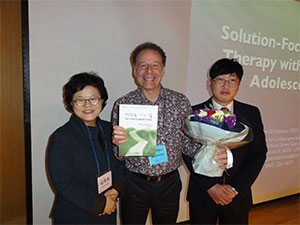
Matthew’s book Pathways to Change: Brief Therapy with Difficult Adolescents, Second Edition was just published in Korean. A copy was presented to me at my workshop in Seoul, which was hosted by the Korean Solution-Focused Brief Therapy Association.